中文 (简体)
As part of a broader effort to modernize public administration, improve passenger experience, and align Vietnam with global trends in smart airport infrastructure, Vietnam has been improving its airport immigration procedures through the introduction of automatic immigration gates, commonly known as Autogates. This article provides details about Vietnam Autogate Immigration at major international airports, including Noi Bai, Tan Son Nhat and Da Nang.
Vietnam Autogate Immigration
These automated systems, deployed by the Vietnam Immigration Department under the Ministry of Public Security, aim to streamline border control, ease the congestion, and enhance security through the use of biometric verification, including facial recognition and fingerprint scanning.
The initiative began in August 2023 with pilot scheme operations at 05 international airports including Noi Bai (Hanoi), Tan Son Nhat (Ho Chi Minh City), Da Nang, Cam Ranh (Khanh Hoa), and Phu Quoc (Kien Giang).
Both foreigners and Vietnamese can use Autogate under these conditions:
| FOREIGN passengers | VIETNAMESE citizens |
Eligible for:
|
Eligibility and registration requirements depend on the passport type and travel circumstances. Vietnamese citizens with eligible biometric passports may use Autogate without prior registration, while other cases may need to register before first use. |
Note for foreign tourists: Most short-term visitors entering Vietnam with an eVisa, tourist visa or visa exemption are currently not eligible to use Autogate unless they also hold a valid Vietnamese Temporary Residence Card or Permanent Residence Card and have completed the required registration.
Benefits of Autogates at Vietnam Airports
The introduction of Autogates has brought several benefits, including:
- Save time: decrease the Immigration procedure processing times from an average of 02 to 04 minutes for manual checks to about 30 seconds per passenger.
- Improve passenger experience: Shorten queues at Immigration counters, reduce congestion and improve the passenger experience.
- Ensure transparency: Enhance security and minimize the risk of documents fraud or identity fraud. Immigration officers can now focus on exceptions and security concerns, increasing operational efficiency.
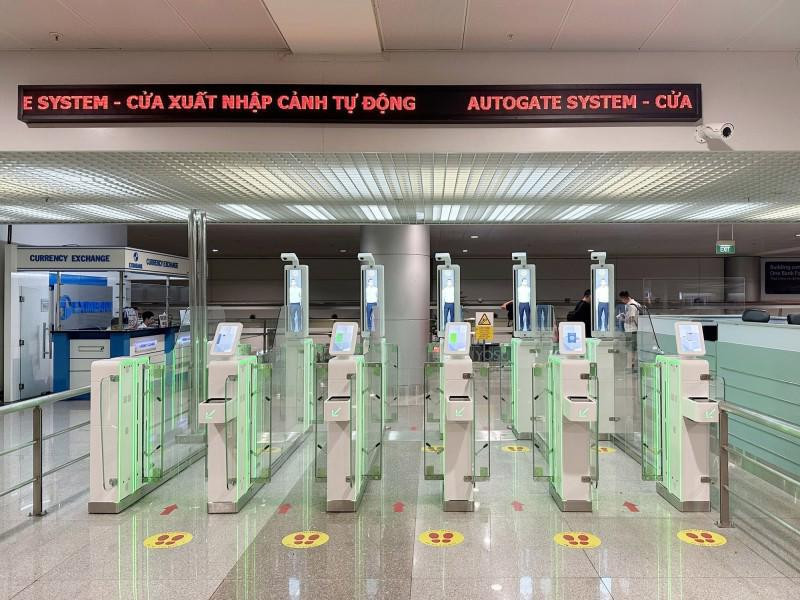
*Image source: Vnexpress
Autogate Immigration procedures
To get through Autogate, please:
- Complete the registration for using Autogate at Autogate Automatic Registration Machine or Autogate Automatic Registration Counter;
- After successfully completing registration, please go to Autogate System to finish Immigration procedure;
Each gate has 02 layers, of which the whole process will be displayed as below:
- At the 1st layer: scan your passports and boarding passes;
- At the 2nd layer: biometric checks (portrait photos taken and fingerprints scanned);
- Successful verification allows the gate to open without a physical passport stamp, while any mismatches redirect passengers to manual processing.
Autogates at Vietnam Airports
At Noi Bai (Hanoi) and Tan Son Nhat International Airport (Ho Chi Minh City/ Sai Gon), the Autogate system was implemented in both arrival and departure zones of International Terminal T2, featuring 10 Automated gates, of which 05 for Arrivals and 05 for Departures on a trial basis in early August 2023.
In the Vietnam central, Da Nang International Airport became a showcase for fully automated Immigration when its Autogate system was officially handed over to the Immigration Department in March 2025, involving 04 gates and 02 registration counters.
Notes when using the Vietnam Autogate Immigration
- Make sure your Vietnam visa is still valid when you leave the country, do not overstay;
- To easily move through the gate, limit carrying of bulky or oversized luggage;
- Keep your boarding pass with barcode ready to scan at the Autogate (if required);
- Your passport will not be stamped when using the Autogate;
- The Autogate system may occasionally malfunction. If there is a problem, please contact the security staff at the gate for assistance;
- Follow the regulations, maintain order and general security at the automatic control gate area;
- Cooperate with the security staff when requested;
- Children under 14 years old currently cannot use Autogate and should complete immigration procedures at a staffed counter with their parent or guardian.
- If you are unfamiliar with the airport, want to save time and skip lines at the airport, consider using Vietnam VIP Departure Immigration service;
In conclusion, the deployment of Automatic Immigration gates represents a significant step in Vietnam’s airport modernization efforts, offering faster, more convenient, and more secure border processing for passengers. Vietnam may continue to expand eligibility to more foreign travelers and extend Autogate deployment to more and more airports.
Hope this is helpful for your Immigration procedures, and in case you need any support, please feel free to Reach out to us via Hotline/ WhatsApp/ Viber/ Zalo +84 86 517 8972, OR email sales@vmetravel.net.
You may also need:
- Noi Bai Airport (HAN): How to transfer between International and Domestic Terminal? Check here.
- Tan Son Nhat Airport (SGN): How to get from International to Domestic Terminal? Check here.
Frequently Asked Questions
Disclaimer: While we put an effort to ensure that the provided information is correct and up-to-date, there are probably changes which we are unaware of.